
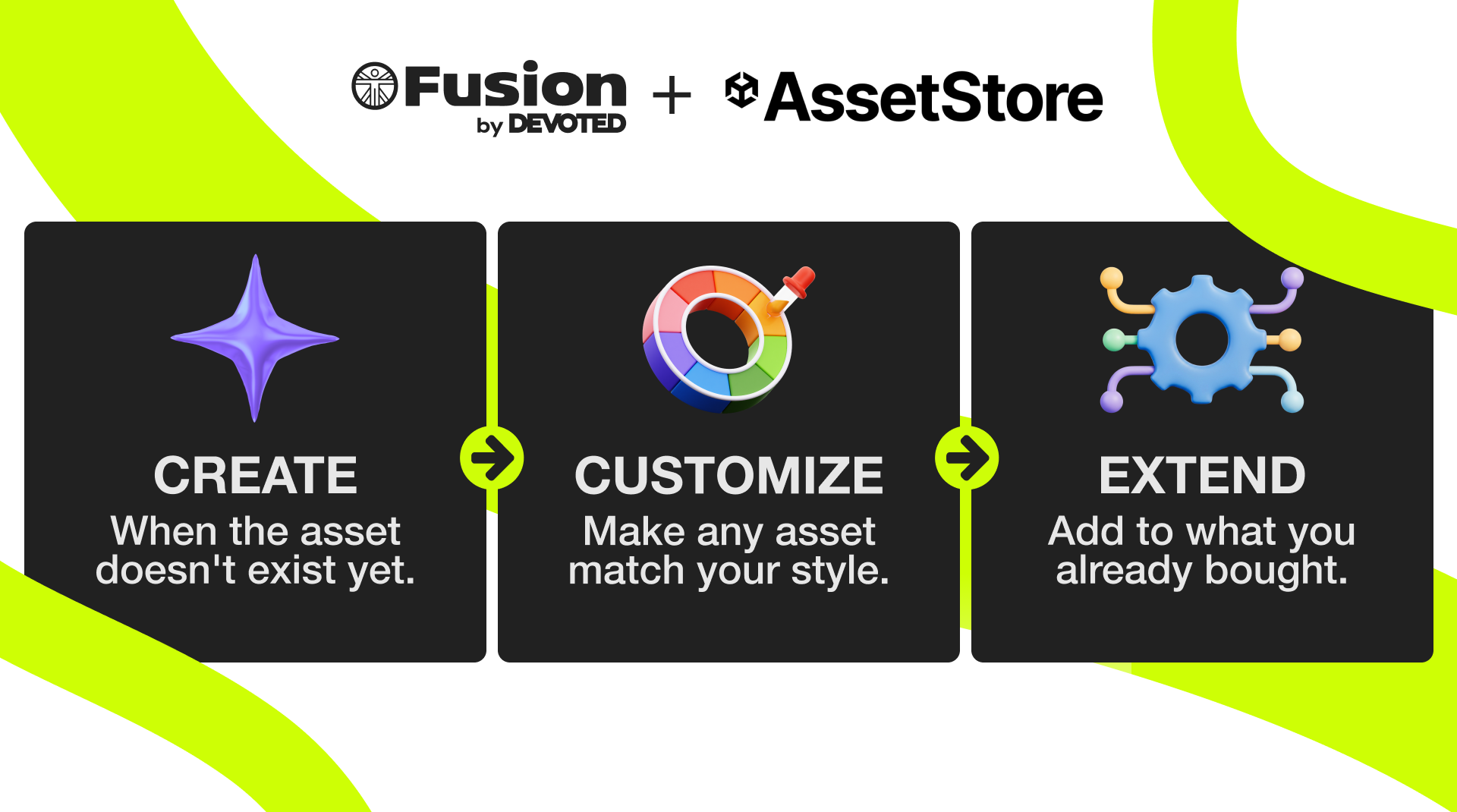
Fusion by Devoted will bring asset sourcing and artist hiring into a single workflow into the Unity Asset Store.
For game studios, this changes what happens after an asset is purchased. Studios can move from the Unity Asset Store to Fusion by Devoted to find artists who can customize, extend, or adapt that asset, without starting a separate talent search.
This arrives as studios across AAA, AA, and indie development face tighter schedules, smaller core teams, and increasing content expectations.
Bringing Assets and Artists Together
You’ve probably been in a situation where you’re in the Unity Asset Store, scrolling through packs, and you come across something that looks almost perfect… almost .
 The style is almost there.
-
It needs a few custom props.
-
Maybe better LODs.
-
Maybe some tweaks so it really fits your game.
So you close the Unity Asset Store. Open LinkedIn or Upwork. Start DMing artists. Review portfolios. Wait for responses.
3 days later? You’re still briefing people.
We heard you. That’s why Fusion by Devoted is being better integrated with Unity Asset Store. Studios already rely on the Unity Asset Store to accelerate production. Asset packs help teams move faster, especially during early builds, prototyping, or live content updates. But in reality, assets are rarely drop-in ready.
They need:
-

Style matching -
New variations -
Performance optimization -
IP-specific changes -
Additional props, animations, or VFX
From Asset Purchase to Production, Without the Usual Overhead
If the Asset Store doesn’t have exactly what you’re looking for, you don’t have to settle for “close enough.” Through the Unity Asset Store and Fusion by Devoted connection, you can build on existing assets or create what’s missing, without breaking your flow.
-
Style matching
You find a character or environment pack, but it doesn’t match your game’s look. Connect with artists who adapt the asset to your art style. -
Expanding a world
You have a medieval village but need 20 more props to fill it out. Brief artists on what’s missing and build on top of the existing asset. -
Performance optimization
An asset looks great, but needs work to hit performance targets. Work with technical artists to optimize it for your platform. -
Building something new
The asset you need doesn’t exist yet. Commission original work that fits your pipeline and creative direction.
Same flow. Same ecosystem. A more direct path from asset selection to usable content.
Built for How Studios Work Today
More than 15,000 industry layoffs hit in 2024. [Source: Insider Gaming, “Every Known Games Industry Layoff in 2024,” https://insider-gaming.com/every-known-games-industry-layoff-in-2024/, 2024] Teams are leaner, timelines are tighter, and content demands continue to grow. Players expect frequent updates, new cosmetics, new environments, and more variety across live games and ongoing projects.
At the same time:
Player engagement has dropped to an average of eight hours per week
[Source: Newzoo, “The PC & Console Gaming Report 2025,” https://newzoo.com/resources/trend-reports/the-pc-console-gaming-report-2025, 2025]
Only 12 percent of playtime goes to new releases
[Source: Newzoo, “The PC & Console Gaming Report 2025,” https://newzoo.com/resources/trend-reports/the-pc-console-gaming-report-2025, 2025]
AAA budgets now sit well above $150–300 million
[Source: UK CMA / IDG report, via “The Costs of AAA Game Development,” https://ejaw.net/the-rising-costs-of-aaa-game-development/, 2024]
Studios are under pressure to deliver more, with less margin for delay. More than 1,000 external partners now support studios across the industry, and freelance engagement continues to grow. External development is no longer an exception. It is part of everyday production. What studios need is not more platforms to manage, but better integration with the tools they already use.
Supporting Distributed Teams Without Slowing Them Down
Distributed development is now standard across AAA and AA studios. External artists support core teams across environments, characters, animation, VFX, and live updates.
Yet managing that work often creates overhead:
- Sourcing talent
- ➜
- Reviewing portfolios
- ➜
- Onboarding
- ➜
- Aligning expectations
- ➜
- Coordinating schedules
With Fusion by Devoted now available through the Unity Asset Store, Unity developers and studios can seamlessly access a curated network of professional artists, enabling them to quickly find the right talent to meet their production needs. This streamlined approach helps teams scale creative resources efficiently, accelerate development timelines, and deliver high-quality content with greater speed and flexibility.
This is especially relevant for Unity Asset Store users. Fusion by Devoted’s 2025 Freelancer Report highlights growing talent hubs in Vietnam, the Philippines, Malaysia, Brazil, Argentina, Mexico, Nigeria, and Egypt – regions that map directly to Unity’s strengths in mobile, UGC, stylized pipelines, and rapid iteration. Our integration with the Unity Asset Store gives studios of all sizes a faster path to the talent most aligned with how they build. Instead of treating external artists as a separate workflow, teams can bring them into production where asset decisions are already being made.
Faster Iteration, Fewer Gaps
Fusion by Devoted already enables teams to move from idea to active production in under 72 hours. Connected to the Unity Asset Store, that speed supports how studios actually iterate.
Teams can:
-
Build vertical slices faster
-
Iterate content more frequently
-
Explore art directions in parallel
-
Support live updates without slowing core production
For studios managing feature changes, live-service demands, or shifting creative direction, reducing handoff time helps protect schedules and budgets.
A Hybrid Approach to Game Production
Fusion by Devoted supports a production model many studios already follow:
-
Reusable assets from the Unity Asset Store
-
IP-specific extensions built by external artists
-
Distributed teams scaling around a lean core
This hybrid approach helps studios stay flexible while maintaining control over quality and direction.

“Studios already know what asset they need. They get stuck on what comes after — finding the right person, briefing them, getting them onboarded. We built a deeper integration into the Unity Asset Store to absorb that overhead so teams can stay in production, not in admin.”
— Ninel Anderson, CEO at Devoted.
What This Means for Studios
Devoted Fusion is now directly accessible through the Unity Asset Store, enabling developers to seamlessly transition from asset discovery to custom artist collaboration when the exact style and variation isn’t available. The result is a workflow designed for the realities of modern game development — supporting distributed teams, independent creators, tight production timelines, and continuous iteration.
“The most efficient teams we work with aren’t necessarily the biggest — they’re the ones with adaptable pipelines. If an asset can’t be found immediately, creators shouldn’t lose momentum. They should be able to move directly into creation with the right artists and keep production moving forward.”
— Ninel Anderson, CEO at Devoted.
For studios building with Unity, this offers a more direct path from asset selection to production-ready content, through tools they already trust.